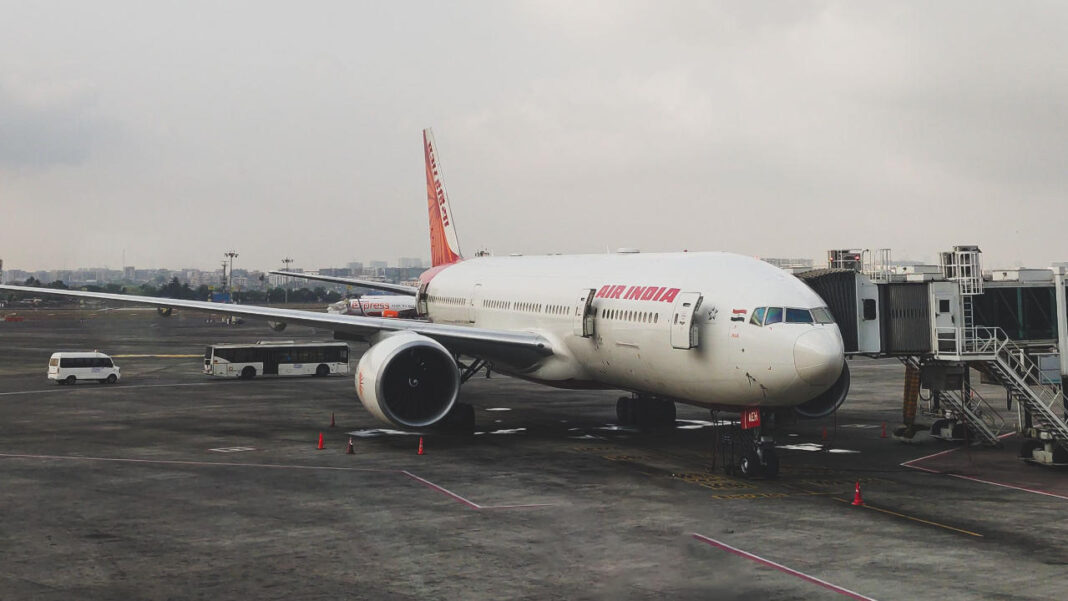

On July 7, 2026, a runway incursion at Chhatrapati Shivaji Maharaj International Airport in Mumbai was narrowly averted. An Air India flight preparing to depart for Delhi aborted its takeoff on the instructions of Air Traffic Control because an incoming Air India Express flight had not yet cleared the runway.
The said incident involved the flight AI816 of Air India due to operate between Mumbai and Delhi, which started moving on the runway for take-off. The ATC became concerned when the Boeing 777-300 aircraft was about to take off, but the runway was actually occupied by another flight, AIX1547, from Air India Express, which was arriving from Siliguri. The ATC stopped the takeoff with timely intervention, which saved the flight from any accident.
Air India provided the confirmation regarding the series of events. The airline disclosed that the airport authorities interrupted the take-off after a prompt notification to the cockpit crew via the air traffic control tower was made. The airline explained that it would ensure that all requirements of the standard operating procedures were complied with and that the plane would undergo requisite checks before it was allowed to take off again. Hence, passengers were taken care of throughout the situation. The frightening aspect of this incident is the total lack of margin for errors that exists in an active take-off. Taking off is the time when the plane moves faster on the runway in preparation for such a breakneck flight, and at that stage, any intervention can mean that it is a matter of emergency. Fortunately, the well-timed actions of the pilot and air traffic control prevented the situation from resulting in a tragedy, and there were no injuries.
Such an event would present a key example that illustrates how technical processes in aviation can easily result in sometimes hazardous scenarios when everything goes wrong. The scale of the two aircraft involved is another important factor to take into account. AI816 consisted of a larger and more sophisticated Boeing 777-300ER; then again, the Air India Express aircraft was a smaller Boeing 737 MAX 8. Mumbai airport itself is said to normally handle around 980-1000 flights each day and around 48 air traffic movements every hour, therefore presenting little margin for error.
In principle, flying is supposed to be a smooth process, yet such smoothness does not always happen in practice, as flights can be disrupted from time to time. Such flight disruptions emphasise the necessity for the aviation industry to ensure that there are various safety procedures and regulations that must be followed to ensure that aviation is safe to operate. Some of the procedures include the times at which flights leave and arrive, as well as the requirement for obtaining runway clearance, among other operations that take place to ensure safety in flight operations. When such safety procedures are adhered to at all times, they can help avoid accidents, underscoring the importance of caution. At all times, accidents are likely to be avoided; hence, the need to be cautious.
Air travel is considered one of the safest means of transportation, and this information does not only apply to the flight passengers but also to the aviation authorities who run the flights. Despite aviation safety advancements that make flying the safest mode of transport, turbulence occasionally disrupts flights.
There are many aspects involved in a flight, and they are all governed by strict rules and regulations. Some of these aspects include selecting the appropriate time for a flight to take off, making sure that the runway is cleared for takeoff, and following orders from the control tower. In the aviation industry, no rule is arbitrary; each regulation has been established based on decades of lessons learned from past air crash investigations. When an anomaly occurs—such as two aircraft converging too closely or an unexpected obstacle on the tarmac—the seamless application of these safety protocols becomes the ultimate line of defence.
Because of the rigid adherence to ICAO and global aviation standards, all necessary corrective processes and communication flows often take place in a highly timely manner. In a critical scenario, if air traffic controllers and flight crews identify an escalating threat and execute their emergency or corrective procedures swiftly, a catastrophic disaster can be avoided. Such outcomes, while unsettling, reiterate the robustness of the global aviation safety framework and the critical human decisions that continuously keep passengers secure in the sky.