
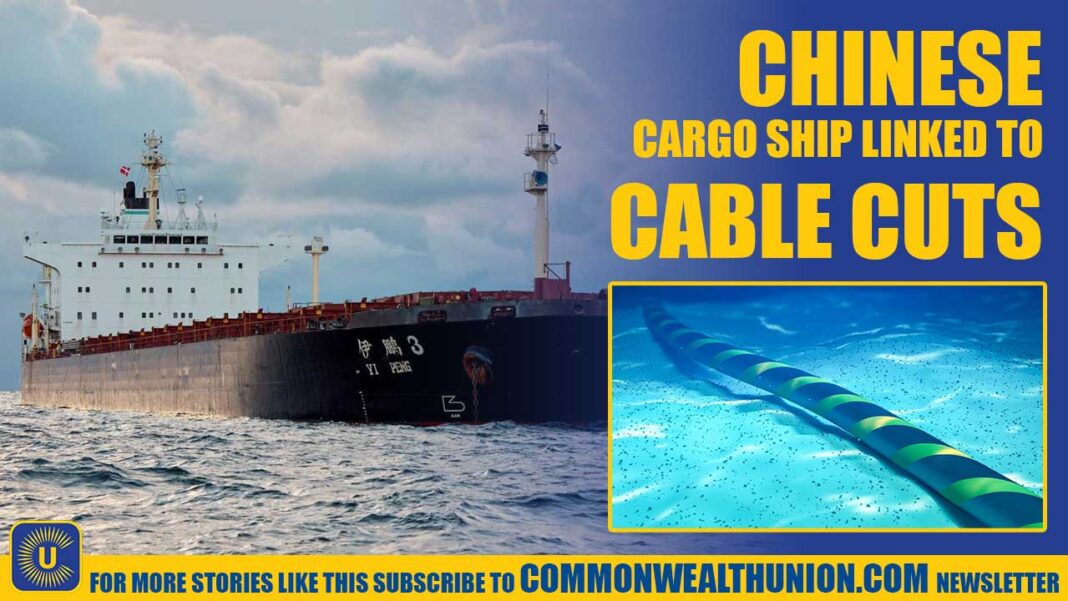
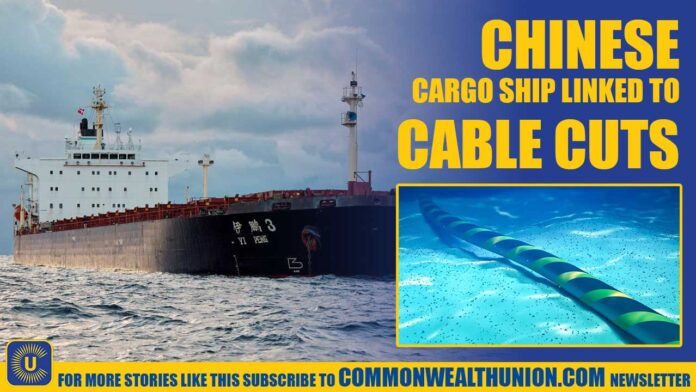

The Baltic Sea, also known as the “NATO lake”, due to its bordering NATO countries, has become the focus of heightened security concerns following the severing of 2 critical undersea data cables earlier this month. European investigators suspect a Chinese cargo ship, Yi Peng 3, may be involved in what appears to be deliberate sabotage.
On November 15, the Chinese cargo ship departed from a major Russian port, Ust-Luga, on the Baltic Sea. Carrying a load of Russian fertilizer, the vessel dropped its anchor on November 17 and reportedly began an unusual and concerning journey. According to an Investigators Report, Yi Peng 3 had dragged its anchor for over 100 miles along the seabed, severing a telecom cable between Sweden and Lithuania. Less than 24 hours later, the ship is believed to have damaged another undersea cable connecting Finland to Germany.
This behavior has been deemed highly irregular, raising suspicions of intentional sabotage. Experts noted that dragging an anchor for such an extended distance is not only inefficient but dangerous, as it risks damaging the vessel and depleting fuel reserves. Maritime analysts have seemingly pointed out that standard protocol would require a crew to either recover or jettison an anchor in such situations, making the actions of the Yi Peng 3 highly questionable.
The severed cables have disrupted critical communication lines between NATO countries in the region, heightening tensions in the strategically significant Baltic Sea. Since Finland and Sweden joined NATO, the Baltic has been considered a vital and vulnerable point for alliance operations. The incident adds to growing concerns over potential geopolitical interference in the region, particularly Russian involvement and Chinese world vessels.
Allegedly, Swedish authorities have formally requested cooperation from Beijing to clarify the events surrounding the incident. However, China’s foreign ministry has denied any wrongdoing, with the Chinese port of Ust-Luga remaining silent on the matter. Meanwhile, Yi Peng 3 is anchored in the Kattegat Strait under surveillance by Danish naval vessels.
Prime Minister Ulf Kristersson emphasized the seriousness of the situation, stating that the Baltic Sea has become a high-risk zone for activities that threaten regional security. ”As investigations continue, European leaders are calling for greater vigilance and cooperation to prevent further disruptions to NATO’s critical infrastructure.


