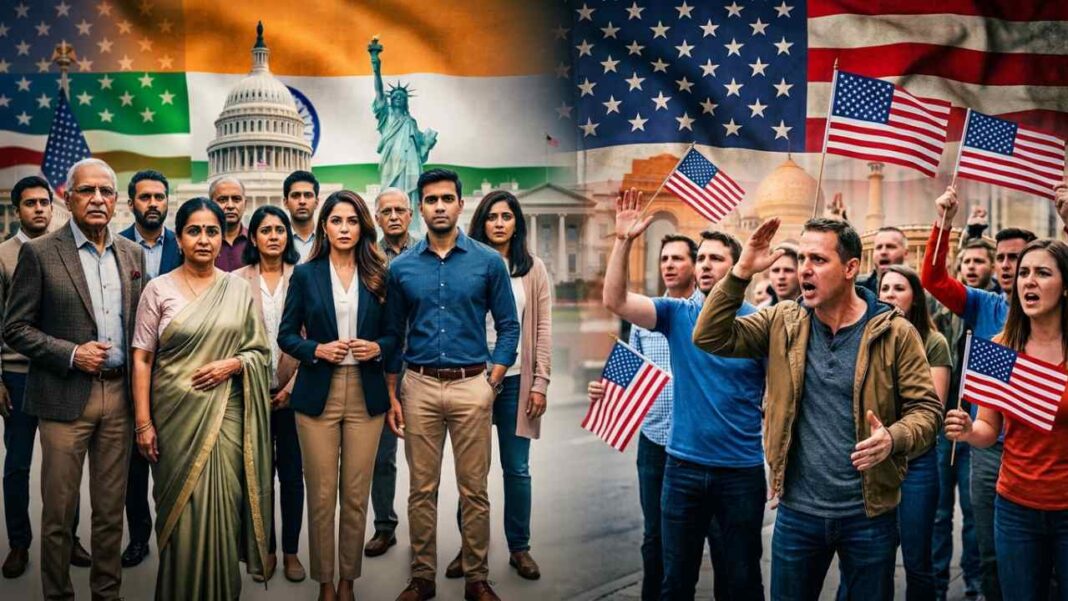

India (Commonwealth Union)_ Despite their enormous contribution to American society, Indian Americans still continue to face increasing racial hostility, religious prejudice and online abuse. The backlash has prompted serious concerns about the safety and acceptance of one of the most successful immigrant groups in America, with Hindu temples attacked and hate-filled campaigns on social media. The situation is particularly troubling because Indian Americans have played an important role in the country’s economic growth, technological development, healthcare system and education.
Furthermore, recent threats against Hindu places of worship have brought this hostility into sharper focus. However, the problem extends beyond individual incidents. Anti-Indian rhetoric has increasingly appeared in online discussions about immigration, employment and cultural identity. To understand why a community that has contributed so much to the United States is becoming a target of hatred, it is necessary to examine recent incidents, political reactions and the long history of racial discrimination against South Asians.
The temple attack: When online hatred threatened lives
A disturbing incident near Chicago exposed the potential consequences of growing anti-Indian extremism. Accordingly, Alexandros Paporakis, 19, of Palatine, Illinois, was arrested after he allegedly plotted a mass shooting at a Hindu temple in Aurora during the Navratri festival. Investigators said the suspect had articulated violent intentions against people of Indian origin and allegedly wrote a document containing white supremacist and neo-Nazi views. His colleagues reportedly became concerned after receiving electronic messages describing plans for an attack. They alerted authorities, allowing the police to investigate before further violence occurred. Investigators subsequently recovered a rifle, loaded magazines, ammunition, body armour and other tactical equipment from his residence. They also found a document titled ‘Why I Fought: A.K.A. (Aurora Shooter’s Manifesto)’, which allegedly contained racist statements targeting Indians, Jewish people and Black Americans.
Police also discovered that a vehicle registered to the suspect entered the parking area of a Hindu temple in Aurora and remained there for about 13 minutes. Prosecutors said the suspect plotted to launch an attack that day. The incident was particularly jarring because Congressman Raja Krishnamoorthi and his family were reportedly at the temple to worship. No shooting or injuries were confirmed, but the alleged plan showed how racial prejudice can become a serious security threat. The suspect was arrested and charged with making a terrorist threat and unlawful possession of weapons. A judge subsequently ordered his detention. The incident was not simply a threat against a religious institution. It raised wider concerns about the safety of Indian Americans and their right to practise their religion without intimidation.
Online hate speech and the rising anti-Indian campaign
The hostility facing Indian Americans is not just physical threats. There is an increasing use of social media platforms to spread racist comments, stereotypes and anti-immigrant narratives. Indians are often portrayed as outsiders who take American jobs, abuse immigration programs or threaten the country’s cultural identity. The H-1B visa debate has been pretty heated with some users portraying Indian professionals as a threat to American workers rather than acknowledging their contributions to the economy. Some online campaigns have also used inflammatory language and misleading videos describing Indian immigration as an invasion. These stories feed resentment by holding an entire community responsible for economic and social ills.
Religious prejudice is another disturbing feature. Hindu Americans are sometimes described using derogatory religious language, while Hindu deities and places of worship become targets of mockery and threats. Additionally, calls to remove or destroy Hindu temples have also appeared in online discussions. Such rhetoric is dangerous because repeated exposure can gradually normalise discrimination. What begins as an offensive social media post can create an atmosphere in which threats, harassment and even violence appear acceptable. The problem also affects Indian Christians and other South Asian communities, who may face discrimination based on their appearance, ancestry or perceived foreign identity. The growing hostility therefore cannot be understood as an issue affecting only one religious group. It reflects a wider problem of racial exclusion.
Indian American lawmakers and organisations condemn the attack
The alleged temple attack prompted strong reactions from Indian American lawmakers, civil rights organisations and community representatives. Congressman Raja Krishnamoorthi expressed concern over the incident, particularly because he and his family were present at the temple. He warned that anti-Indian hatred and white supremacist extremism posed a serious threat to public safety. Other Indian American lawmakers also condemned the alleged plot. Congressman Ro Khanna expressed outrage, while Congresswoman Pramila Jayapal welcomed the action taken by law enforcement and highlighted the wider concerns facing South Asian communities. Congressman Ami Bera also criticised the alleged attack and stressed the importance of protecting Americans from violence motivated by racial or religious prejudice. Other representatives, including Brad Schneider, Yassamin Ansari and Tom Suozzi, also joined the condemnation.
Local and state officials also responded. Aurora Mayor John Laesch described the alleged plan as unacceptable, while Illinois Governor JB Pritzker reaffirmed the importance of protecting religious communities. Community organisations also called for greater vigilance. Additionally, the Hindu American Foundation urged Hindu Americans to remain alert and report suspicious activity. The Indian American Advocacy Council called for stronger scrutiny of online platforms and individuals spreading extremist anti-Indian rhetoric. The reactions show that the issue has resonated beyond the Indian American community. But condemnation alone will not solve the problem. Stronger enforcement against credible threats, greater platform accountability and sustained public education are necessary to prevent online hatred from turning into real-world violence.
The Indian government calls for greater protection
The Indian government also expressed concern over the incident and urged American authorities to take the matter seriously. India’s Ministry of External Affairs called for a thorough investigation, accountability and stronger measures to protect people of Indian origin. Spokesperson Randhir Jaiswal stressed the importance of protecting Indian Americans and their right to practise their religion without fear. The Indian Consulate General in Chicago welcomed the timely intervention of American law enforcement and maintained contact with members of the local Indian community.
Meanwhile, the Sri Venkateswara Swami Temple in Aurora increased its security following the incident. Extra security measures were also taken to protect worshippers and stop possible threats. India’s reaction signals a more general concern about the treatment of its citizens and diaspora abroad. The US has a responsibility to safeguard everyone who lives in the country. Any harm against Indian Americans will also have an impact on India-US relations. The issue requires cooperation between both governments, particularly in addressing organised extremism, online incitement and threats against religious institutions.
Also read: Thirteen years of learning, one incredible invention: Meet India’s flying car innovator!
The long history of American hostility towards Indians
The recent rise in anti-Indian hatred is not entirely new. Indians and other South Asians have experienced racial discrimination in the United States for more than a century. The first major wave of immigration from the Indian subcontinent took place in the late nineteenth and early twentieth centuries. Many were looking for jobs for economic reasons. But some sections of the white population regarded them with suspicion and hostility. All Indians were generally called Hindus regardless of their actual religious beliefs. Newspapers and political pundits described their arrival as a Hindu invasion to portray them as a danger to American society. This prejudice was fuelled by economic competition. In 1907, mobs in Bellingham, Washington, attacked Indian workers and forced many of them out of the area.
Anti-Asian organisations also campaigned against immigration from the Indian subcontinent. Legal discrimination further reinforced their exclusion. In 1923, the US Supreme Court ruled in United States v. Bhagat Singh Thind that Indians were not considered white under the naturalisation laws then in force. This prevented many Indians from becoming citizens of America. Earlier restrictions on property ownership and immigration had also limited opportunities. However, the situation gradually changed following the passage of the Immigration and Nationality Act of 1965, which eliminated the discriminatory national-origins quota system. The legislation opened the door to larger numbers of immigrants from India, particularly professionals, scientists, doctors and engineers.
However, greater economic success did not eliminate prejudice. During the 1980s, Indian immigrants in New Jersey faced attacks from a group known as the Dotbusters. Indian women wearing bindis and people displaying other visible signs of their cultural identity were among the targets. Hindu temples were desecrated in various parts of the country. These events demonstrated that economic advancement and social integration did not ensure acceptance. Some of the same exclusionary attitudes have reappeared today, in a different form. Instead of openly opposing all immigration, certain groups use arguments about jobs, cultural identity and national security to target specific immigrant communities.
How Indian Americans rose to prominence
The changes introduced by the 1965 immigration legislation transformed the Indian American community. Over subsequent decades, Indian immigrants established themselves in technology, medicine, engineering, education, business and public administration. Their educational achievements and professional success have made them one of the most prominent and successful immigrant communities in the United States. Indian Americans have also become influential entrepreneurs, university professors, researchers and political representatives.
This success, however, has sometimes generated resentment. Instead of recognising the value of their achievements, some critics portray their professional progress as evidence that they are taking opportunities away from native-born Americans. This argument ignores the wider economic benefits of immigration. Indian professionals have helped develop major technology companies, strengthen healthcare services, establish businesses and create employment opportunities. Their success is not evidence of American decline. It is evidence of what people from different backgrounds can achieve when they have access to education, opportunity and a fair economic system.
The contribution of Indian Americans to the United States
Indian Americans have become an important part of America’s economic and social development. And their contributions reach far beyond tech. Indian-origin doctors and healthcare professionals serve communities across the country, and Indian-origin scientists and engineers help advance research, innovation and technologies. Entrepreneurs have built successful businesses, created jobs and reinvested funds into local economies. Indian Americans have also enriched American universities by their research, teaching and student participation. International students from India contribute to higher education institutions and support economic activity in the communities where they study.
We also see the results of their work in public life. Indian Americans have entered the US Congress, state legislatures, local governments and public institutions and helped shape policy and represent the interests of diverse communities. They have also contributed to American society by way of food, festivals, religious institutions, cultural activities and community organizations. But even with those achievements, many still face stereotypes and discrimination and questions of whether they really belong in the country. This contradiction is at the heart of the current crisis: a community that contributes significantly to American prosperity is increasingly being treated by some as an unwanted outsider.
American diversity must not become a target of hatred
America’s strength has historically rested on its ability to welcome people from different backgrounds and allow them to contribute to a shared national future. The growing hostility towards Indian Americans challenges this principle. The alleged attack on a Hindu temple near Chicago, together with the spread of anti-Indian rhetoric online, should serve as a warning. Racial hatred must never be dismissed as harmless political commentary or ordinary disagreement about immigration. The American government must ensure that credible threats are investigated, extremist violence is prosecuted and religious institutions receive appropriate protection. Social media companies must also take greater responsibility for content that encourages racial intimidation and violence.
At the same time, political leaders and community organisations must promote honest conversations about immigration, employment and cultural diversity without turning entire communities into scapegoats. Indian Americans need not have to justify their presence or prove their loyalty every time racial prejudice appears. They are also Americans who advance the country, engage in its democratic institutions and help shape its future. Ultimately, the answer to anti-Indian hatred is not division or retaliation, but equal protection, accountability and mutual respect. In a country that depends on the labor and skills of immigrants, their dignity and safety must also be protected. Indian Americans deserve not merely recognition for their contributions, but most importantly, security, freedom and a sense of belonging promised to every American.