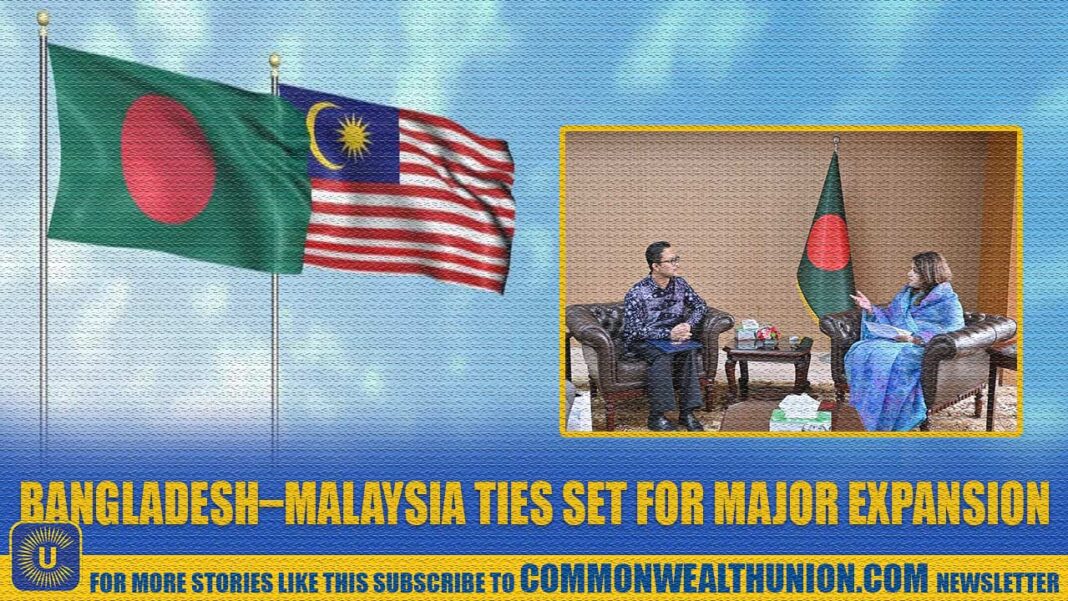

Bangladesh (Commonwealth Union)_ Bangladesh and Malaysia have reiterated their commitment to strengthening bilateral ties, with both sides emphasizing the importance of expanding cooperation across a wide range of sectors. The discussion took place when State Minister for Foreign Affairs Shama Obaed Islam met Malaysian High Commissioner to Bangladesh Mohd Shuhada Othman during a courtesy call at the Ministry of Foreign Affairs in Dhaka. During the meeting, the Malaysian envoy congratulated the state minister on her new role and conveyed greetings from the government of Malaysia to the newly elected administration in Bangladesh, led by Prime Minister Tarique Rahman.
Also read: Meet India’s most powerful and wealthiest female leaders who rule the business world!
Mohd Shuhada Othman expressed confidence that relations between the two nations would continue to grow stronger under the new leadership. The representative indicated that Malaysia is exploring a potential official visit, inviting the Prime Minister of Bangladesh to come to Kuala Lumpur, creating future opportunities for collaboration along new lines. During the conversation, Shama Obaed Islam (State Minister) emphasized that the priority for the Bangladesh government remains creating jobs for young people and women. She also indicated that Bangladesh is very interested in having more skilled workers sent to Malaysia in areas of increased need for qualified manpower.
Also read: How India’s Kanchipuram saree quietly reached the global fashion stage!
While reflecting on the two nations’ longstanding connections, the state minister commended former Prime Minister Khaleda Zia‘s efforts in improving bilateral relations in the past. She underlined Bangladesh’s commitment to strengthening ties with Malaysia, citing openness, accountability, and good governance as the cornerstone. The two nations pinpointed various areas open for expanded collaboration. These encompassed diversifying trade, fortifying agricultural partnerships, amplifying energy cooperation, and improving supply chain links. Furthermore, they explored strategies to boost exports of Bangladesh’s ready-made garments and broaden trade and investment prospects.
Also read: Big moments from Modi’s high-stakes Israel visit!
The talks also covered cooperation in emerging and high-potential sectors such as the halal industry, semiconductor manufacturing, and agro-based industries. The Malaysian ambassador stated that there is significant potential for technology transfer and industrial collaboration between the two countries. He proposed that Malaysian manufacturers explore manufacturing vehicles in Bangladesh while also providing training opportunities for young Bangladeshi experts. At the meeting, attendees put forth another suggestion—the creation of a Joint Business Council. This type of organization could provide a framework through which businesses in the two nations could build relationships, seek out new investment opportunities, and enhance their economic engagement with each other.
In regard to the nation’s workforce cooperation, the state minister commended Malaysia for issuing Bangladeshi nationals multiple-entry permits. She also stressed the need for vocational training along with professional development to better equip Bangladeshi youth for an international environment when seeking employment. In addition, she noted that there are approximately 10,000 Bangladeshi students attending school in Malaysia and a number of Bangladeshi professors working in universities in Malaysia. To boost economic connections, the state minister proposed increasing Malaysian imports from Bangladesh, which include medications, pottery, jute items, and textiles. She also recommended setting up a joint cultural center in Malaysia to promote Bengali culture, language, and cuisine.
In response, the Malaysian envoy emphasized the benefits of Malaysian investment in Bangladesh, particularly projects involving Robi Axiata Limited and Edotco Group. During the discussion, Bangladesh also requested Malaysia’s assistance for its application to join the Association of Southeast Asian Nations’ Sectoral Dialogue Partner Program. The state minister also asked for Malaysia’s continuing cooperation in tackling the Rohingya situation, namely ensuring the safe and sustainable repatriation of displaced Rohingyas to Myanmar. Both parties expressed confidence in the future of Bangladesh-Malaysia relations and reiterated their commitment to developing the partnership via practical and results-oriented collaboration.