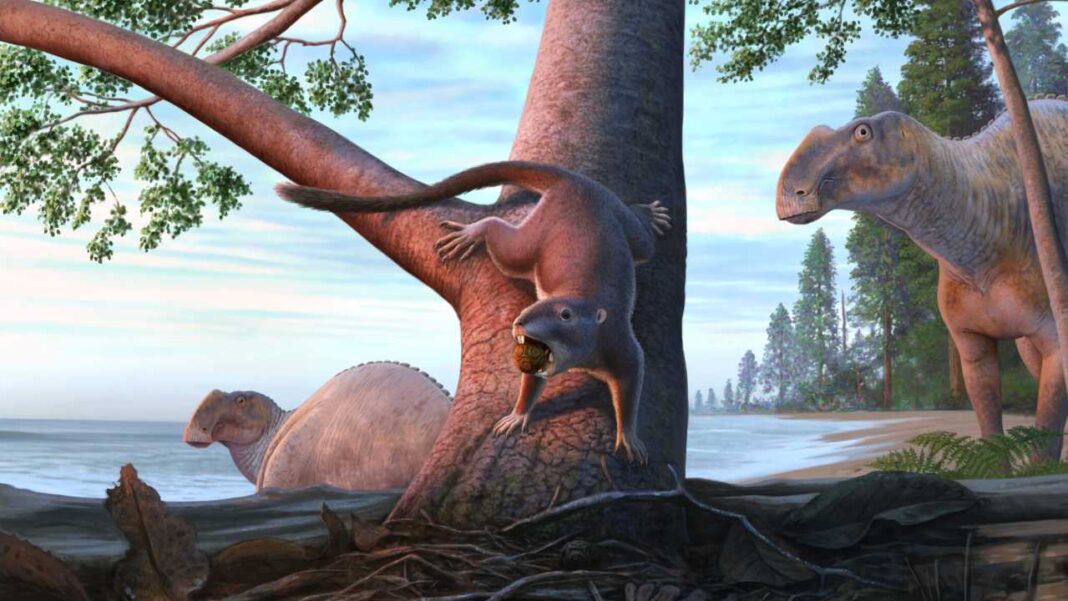

Mammals and dinosaurs lived together on Earth. This coexistence continued until a major disaster 66 million years ago. That event killed 75 percent of life on the planet. Some animals still survived this mass extinction. Among them were small rodent-like mammals from the genus Cimolodon. These animals belonged to a group called multituberculates.
This group first appeared in the Jurassic Period. They survived for well over 100 million years. They eventually became extinct much later. Scientists study them to understand how mammals survived and evolved after the extinction. A research team from the University of Washington studied these ancient mammals. They found a new species within the Cimolodon genus. The fossil was discovered in Baja California. The team estimates the fossil is about 75 million years old. The new species was named Cimolodon desosai.
It was similar in size to a golden hamster. It likely moved on the ground and also climbed trees. Its diet probably included fruits and insects. The findings were published in the Journal of Vertebrate Paleontology. The research team explained that Cimolodon was a common mammal during the Late Cretaceous period. Fossils of this genus have been found across western North America. Their range stretched from Canada down to Mexico. According to Professor Gregory Wilson Mantilla, these mammals were part of the last age of dinosaurs. He works at the University of Washington and studies biology and fossils. He also curates vertebrate fossils at the Burke Museum.
He said Cimolodon desosai likely led to species that survived the extinction. These animals were small in body size. They likely ate both plants and small animals. This flexible diet may have helped them survive difficult conditions, such as periods of food scarcity or environmental changes that affected their habitat. The fossil was first discovered in 2009 at a research site in Baja California. A field assistant initially noticed a small tooth in the rock. The researcher said the tooth alone would have been an exciting find. After closer inspection, more bones were found in a crack in the rock. The fossil included teeth, parts of the skull and jaws. It also contained limb bones such as a femur and an ulna. Finding more than just teeth helped scientists understand the animal better.
It allowed them to estimate its size and shape more accurately. It also gave clues about how it moved. The discovery helped fill gaps in knowledge about the Cimolodon group. Scientists used advanced imaging techniques to study the fossil. They used micro computed tomography, also called ‘micro-CT scanning’. This method produced very detailed 3D images of the bones. Researchers compared the teeth with other Cimolodon species. Tooth structure is important for identifying these ancient mammals.
Many species are classified mainly based on dental features. Sometimes fossils without teeth are difficult to classify, particularly when dental characteristics are the primary basis for species identification. The species was named after field assistant Michael de Sosa VI. He discovered the fossil during fieldwork. He passed away while the study was still ongoing. The researchers dedicated the name in his honour. The study included several co-authors from different universities. These included researchers from the University of Washington. Others came from the University of Rhode Island. Some contributors were from the National Autonomous University of Mexico.
Graduate students and postdoctoral fellows also participated. The research was funded by multiple organisations. Funding came from the UC MEXUS-CONACYT programs. It was also supported by academic grants from the University of Washington. Additional support came from the American Philosophical Society. These funds helped support fieldwork and laboratory analysis. The study improves understanding of mammal evolution after extinction. This discovery is important as it helps scientists to learn how early mammals survived and evolved after the dinosaur extinction event.