
The route has proven its value, especially at times of crisis. Can it evolve into a primary artery of Eurasian trade?
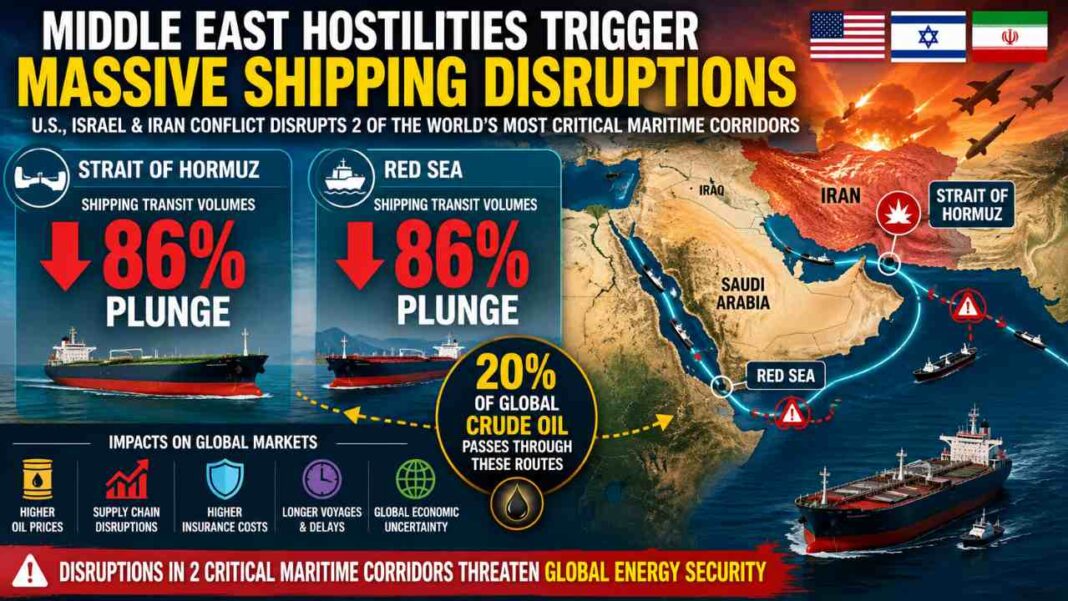
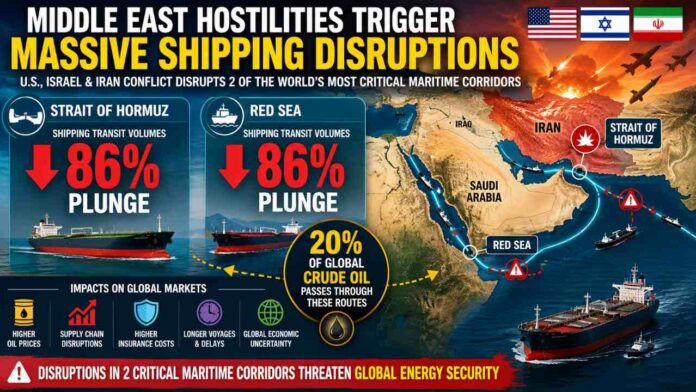
On Saturday, 28 February ’26, the global trade system absorbed one of its most severe single-day shocks in recent history. There was an 86% plunge in transit volumes through the Strait of Hormuz, the narrow chokepoint through which nearly 20% of global oil passes. The drop was due to the escalation of hostilities between the United States, Israel & Iran. This, combined with the ongoing closure of the Red Sea to commercial shipping, meant that the world faced what analysis had long theorised but never fully modelled. This situation represents the simultaneous disruption of two of the world’s most critical maritime corridors.
The world’s largest container carriers, Maersk, MSC, & CMA-CGM, all suspended operations across both routes. This exposed the fragility of a system developed on concentration, besides efficiency.
In this environment, the Middle Corridor, which links China to Europe through Central Asia, the Caspian Sea, the Caucasus, and Turkiye, is evolving from a strategic alternative to an increasingly essential component of Eurasian connectivity.
The present moment’s not the corridor’s first test under pressure. When Russia came under sweeping international sanctions after it invaded Ukraine 4 years ago in ’22, China began redirecting volumes away from the traditional Northern Route – China-Mongolia-Russia-Europe. That was towards the Trans-Caspian pathway. The OECD shared that cargo traffic along the Middle Corridor increased by 2.5 times in ’22 alone. It reached 1.5 million tonnes, driven mainly by geopolitical necessity. 2 years back in ’24, cargo volumes had increased by a further 62% year on year. It reached 4.5 million tonnes. That’s a threefold increase in a mere two years. Today, more than 60% of container traffic along the route consists of Chinese goods bound for Europe.
The present disruption is broader & deeper. As the outbreak of hostilities involves Iran, the corridor has shifted from a strategic option to an operational priority. The earliest signal of the shift appeared not on land but instead in the air. A single day of regional airspace disruption compelled the rerouting or grounding of 1,800 commercial flights across Eurasian corridors. Airfreight rates between South Asia & Europe surged by 70% in the weeks that passed. The narrow air corridor over the Caucasus has been carrying traffic diverted from Russian airspace since 4 years back in ’22. It has effectively become a central transit artery that links Europe & Asia.
What may be unfolding in the skies is perhaps an early signal of deeper structural shifts in how goods are moving across Eurasia.
The disruption of traditional maritime routes carries a measurable price. Rerouting traffic through the Cape of Good Hope adds between 10 & 14 days to voyages. Carriers have introduced war-risk surcharges that range between USD 1,500 and USD 3,500 each container. The International Energy Agency’s authorisation for a 400 millionbarrel release from strategic reserves underscored just how far conditions had shifted beyond normal parameters.
Against this backdrop, the Middle Corridor’s advantages are becoming clearer. A route that bypasses the Strait of Hormuz avoids the Red Sea. It carries no sanctions-related routing exposures and offers something valuable: geographic insulation. That is precisely the kind of resilience that supply chain planners are now beginning to prioritise. With the 1st container train of ’26 completing the Xi’an-Baku segment in a mere 11 days, the corridor becomes competitive.
However, without coordination, expansion simply creates congestion on a larger scale. The crucial question is whether the institutional architecture necessary for effective governance will keep pace with the corridor’s physical expansion.
At the 2nd summit of heads of government of the Organisation of Turkic States, which took place in Baku from April 1 to 2, 2026, OTS Secretary-General Kubanychbek Omuraliev predicted a 10% increase in corridor volumes for 2026. This may build on the nearly 11% growth registered in ’25. That was when transit volumes reached approximately 5 million tons. Kazakhstan has set a target of 5.2 million tons of transit cargo for the year.