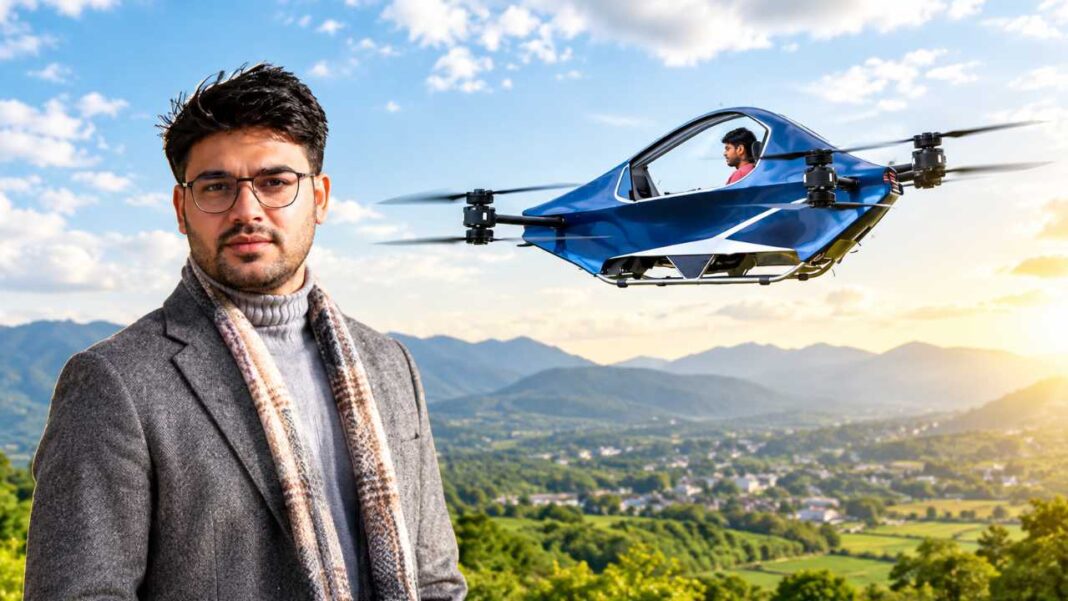

India (Commonwealth Union)_ This Indian innovator has shown how curiosity, determination and knowledge obtained through the internet can help turn an ambitious idea into reality. Almora’s Ravi Tamta, a Bachelor of Arts graduate, has developed an electric flying car prototype after 13 years of self-study and practical experiments, without any formal education in science or engineering. His single-seater vehicle, called HAPIDA SKYNeX, completed a test flight recently. The achievement marks an important step in his journey, which began with a simple ambition in 2015.
Tamta grew up in Kaflikhan, near Jageshwar Dham in Uttarakhand. Living in the mountainous region, he saw how difficult it could be to travel on narrow, winding roads. Reaching a hospital or transporting someone during a medical emergency could take considerable time. These challenges inspired him to explore whether flying vehicles could offer a faster option for short-distance travel. Rather than attending an engineering college or working in a specialised research laboratory, Tamta built his technical knowledge through online resources, repeated experiments and years of practice. His father, Harish Ram, is a mechanic, and family support also encouraged his interest in developing practical solutions.
Also read: Passenger drones over Colombo? Sri Lanka gets ready for drone-powered travel!
Through his venture, Hapida Sky Private Limited, Tamta worked on HAPIDA SKYNeX, an electric vehicle designed to take off and land vertically without needing a runway. It uses multiple electric motors and propellers, drawing on technology similar to that found in multirotor drones. The prototype has a lightweight frame, cockpit and clear canopy, and is powered by batteries. The test flight is a promising milestone, but doesn’t mean the vehicle is ready to carry passengers commercially. More technical evaluations and safety tests are needed to determine its stability, battery performance and structural reliability. Regulatory approvals, including those required from India’s Directorate General of Civil Aviation, will also be necessary before operational use.
Also read: A proud moment for India: Indian social worker Reema Nanavaty wins a prestigious US award!
Tamta’s flying car is not his only attempt at solving everyday problems. His reported inventions include shoes that charge mobile phones, a smart walking stick for people with visual impairments, a bamboo-splitting machine and firefighting equipment. His story is a reflection of the expanding influence of the internet as a source of knowledge. Online information can help people explore subjects beyond their formal education, develop new skills, and experiment with ideas that might otherwise be inaccessible.
But will power alone is no substitute for proper engineering validation, especially when human safety is at risk. Tamta’s story is an inspiring lesson for future innovators. Formal education provides us with a great foundation but learning cannot stop when you leave the classroom. With patience, practical experience and access to knowledge, people can begin pursuing ambitious goals regardless of their academic background.