
Science & Technology (Commonwealth Union) – Frozen samples have always played a crucial role in scientific research as its preservation has paved the way genetic extraction and more detailed evaluations of ancient species.
Researchers have extracted and studied the DNA of a 14,400-year-old woolly rhinoceros that had been preserved inside the stomach of an ancient wolf. Taking into account the timescale of the woolly rhinoceros, the details of the DNA could provide valuable information for future research.
The international research team — from several universities that included Stockholm University, the Norwegian University of Science and Technology, Cardiff University, the University of Copenhagen, and North-Eastern Federal University — found that woolly rhinos were still genetically robust near the end of the last Ice Age. This suggests the species likely vanished after a sudden population crash rather than a gradual weakening over time.
According to Camilo Chacón-Duque, a researcher at the Centre for Palaeogenetics — a partnership between Stockholm University and the Swedish Museum of Natural History — sequencing the full genome of an Ice Age animal recovered from another animal’s stomach had never previously been achieved.
He added that retrieving genomes from creatures that lived shortly before extinction is difficult, but such work can reveal key insights into why species disappear, knowledge that could also help guide modern conservation efforts for endangered animals.
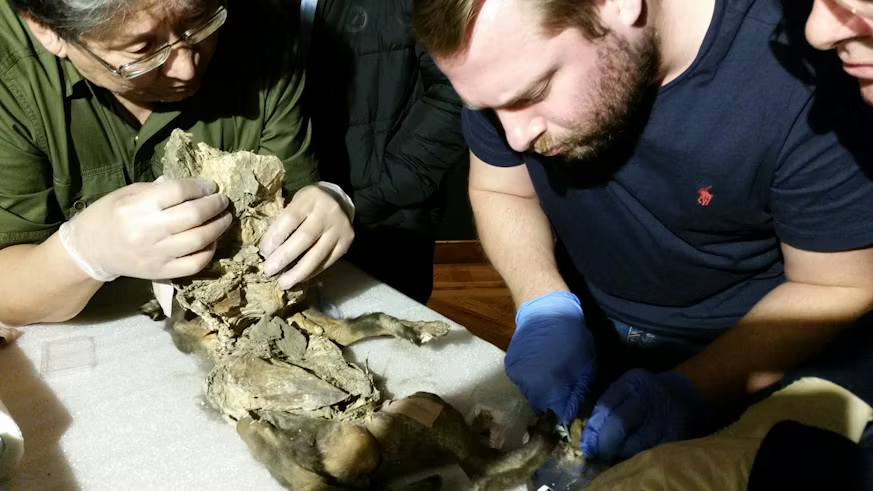
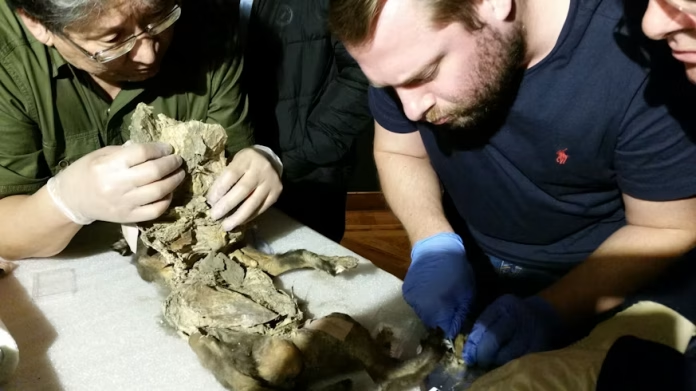
The rhinoceros sample under study originated from the frozen remains of an Ice Age wolf found in permafrost near Tumat, a village in northeastern Siberia. During the wolf’s autopsy, researchers discovered a tiny piece of preserved tissue in its stomach. Radiocarbon analysis showed that the tissue was roughly 14,400 years old, and DNA sequencing confirmed it belonged to a woolly rhinoceros (Coelodonta antiquitatis) – making it one of the most recent woolly rhinoceros specimens ever identified.
Researchers of the study indicated that reconstructing a genome from such material is quite a difficult task. Ancient DNA is usually fragmented and scarce, and the presence of DNA from the predator adds another layer of complexity to the analysis.
Dr. David Stanton, a researcher at Cardiff University’s School of Biosciences, who conducted the work while at the Swedish Museum of Natural History indicated that it was a highly unusual specimen to work with in the laboratory.
“It was initially identified as a piece of cave lion tissue, so it was quite a surprise when the genetic analysis showed that it was actually a woolly rhinoceros.
“When the radiocarbon date came back, we realised how unique the specimen was. The date estimate, very close to when woolly rhinos went extinct, made it incredibly valuable for understanding how and why so many species went extinct at the time.”
Sólveig Guðjónsdóttir who is a student and the lead author of the study, who conducted this research as part of her master’s thesis at Stockholm University indicated that it was incredibly thrilling, though also quite demanding, to reconstruct a complete genome from such an uncommon sample.
The team compared the Tumat rhinoceros genome with two other high-quality genomes from older specimens, estimated to be around 18,000 and 49,000 years old. These comparisons enabled the researchers to explore changes over time in genetic diversity, levels of inbreeding, and the accumulation of harmful mutations throughout the last Ice Age. They found no evidence of genetic decline as the species neared extinction, suggesting that woolly rhinoceroses likely maintained a relatively large and stable population until just before they disappeared.
Edana Lord, who is formerly a postdoctoral researcher at the Centre for Palaeogenetics pointed out that their analyses revealed a surprisingly consistent genetic pattern, with no increase in inbreeding across tens of thousands of years leading up to the extinction of woolly rhinos.
Credit: Cardiff University