
At the United Arab Emirates‘ (UAE) eastern seaport of Fujairah, conveyor belts offloaded grain bulk carriers on Wednesday, 6 May ’26. This occurred while crude oil flowed through pipes and onto tankers docked along the quay.
Dozens of loaded trucks were seen lined up near the seaport. Many others were parked outside, awaiting their turn. Offshore, vessels labelled Cosco, Gardenia, and some other shipping carriers had laid an anchor. Many service boats were seen weaving between them.
Fujairah, along with another eastern seaport, Khor Fakkan, has become the UAE’s economic lifeline with open access to the Indian Ocean since the effective closure of the Strait of Hormuz.
They are now handling the bulk of the UAE’s seaborne trade in place of the major terminals on the UAE’s western coast, located inside the Gulf, where many ships have ended up being stranded.
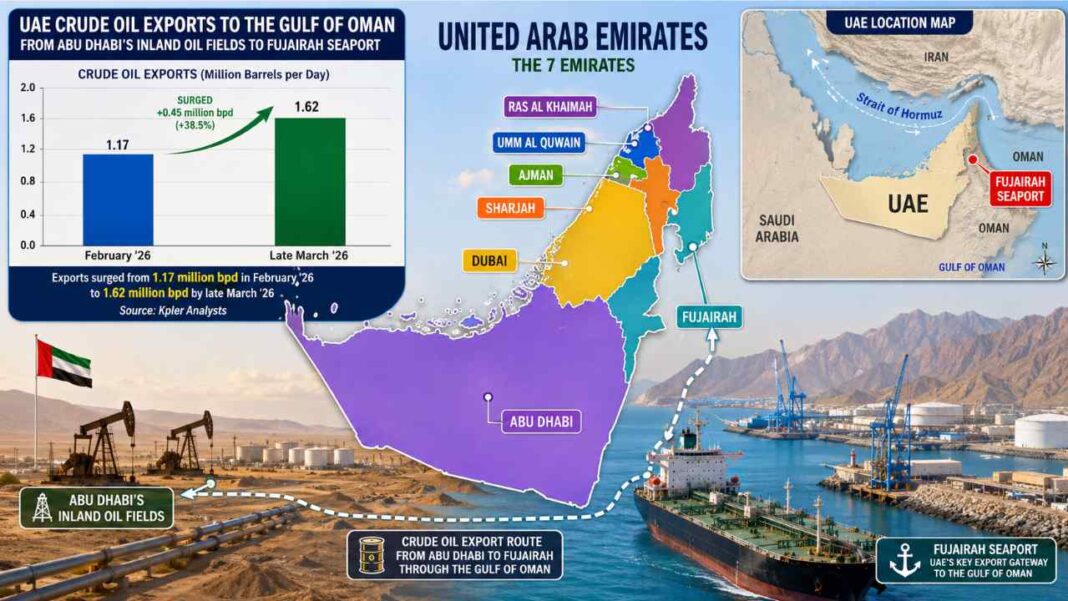
Since the commencement of the Iran war, crude exports through Fujairah have surged 38%, pushing towards the upper limit of the pipeline that supplies this seaport. At Khor Fakkan, terminal operator Gulftainer disclosed that the quantum of containers it handles has increased roughly 25-fold.
On Monday, 4 May ’26, Iran reminded the Gulf region of the vulnerability of its seaports when its drones struck the Fujairah Oil Industry Zone. This attack sparked a fire at one of the UAE’s most crucial facilities. It also injured 3 port workers.
Hours earlier, Iran’s Revolutionary Guards Navy had published a map appearing to extend its zone of control along the UAE’s eastern coastline, which encompassed both seaports. On Tuesday, 5 May ’26, shipping sources reported that neither seaport had been affected yet, although the message from Tehran was clear.
The UAE’s foreign ministry directed Reuters’ request for comment to official statements by the UAE federal & Fujairah authorities. They are ADNOC and the state news agency WAM. Top UAE officials have repeatedly stressed that they reserve the right to respond to attacks against the UAE.
Speaking to a logistics forum in St Petersburg last month, the UAE Energy Minister, Suhail Al Mazrouel, stressed that ‘No country is entitled to disrupt international trade flows or threaten supply routes.’
Fujairah sits at the end of the Abu Dhabi Crude Oil Pipeline. This can carry between 1.5 million & 1.8 million barrels each day (bpd) from inland fields to the Gulf of Oman. It bypasses the Strait of Hormuz, permitting the UAE’s ADNOC to sustain exporting crude oil to global markets.
Crude exports from Fujairah surged to an average of 1.62 million bpd by late March ’26 from 1.17 million bpd in February ’26, as disclosed by Kpler analyst Johannes Rauball. Since the war commenced, Fujairah has begun to accept container vessels regularly for the first time. Kpler, a commodity data collection agency, also disclosed these facts.
Khor Fakkan changes
The transformation of Khor Fakkan has been even more dramatic.
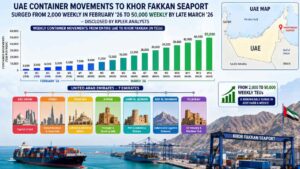
Gulftainer, which also operates this seaport’s container terminal, shared that the quantum of import & export containers it handled every week has increased to 50,000 from a previous mere 2,000.
Kpler data reflect that container vessels’ port calls each day to Khor Fakkan had nearly quadrupled since the war began.
Chief executive Farid Belbouab told Reuters on Tuesday, 5 May ’26, that ‘it has been acting as a critical national gateway’. Belbouab further described this seaport that was historically developed as a transhipment platform but has now become a key hub for imports of everything from groceries to medical supplies.
Truck movements seem to reflect a similar story, Belbouab added. He said that they were moving 100 trucks daily before the war. So now, the movements amount to about 7,000 trucks daily. He further states that the Sharjah-based enterprise hired 900 staff in 2 weeks at the commencement of the war.