


The FWC has issued the 1st ever Road Transport Contractual Chain Order to permit parties in the road transport industry to pass on the increased cost of fuel, even though existing contracts lack a provision for such arrangements.
On Monday, 20 April ’26, the Fair Work Commission (FWC) issued a Road Transport Contractual Chain Order (RTCCO). It commenced operation the very next day. The RTCCO was implemented due to disruptions in the fuel supply chain caused by the present conflict in the Middle East, in addition to the related increase in the cost of fuel.
What’s an RTCCO?
The RTCCO covers most work in the road transport industry. It places obligations on both primary and secondary parties to adjust pay rates either fortnightly or twice for each calendar month to ensure recovery of the increased fuel costs. This is regardless of whether existing contractual arrangements provide for such adjustments. The RTCCO may affect not only transport enterprises & workers but may also apply to those engaging with transport enterprises. The following is an outlined summary of the RTCCO. It includes what the obligations are, such as who is covered & how to ensure compliance.
Section 536PD of the Fair Work Act 2009 (Cth) (FW Act) empowers the FWC to issue an RTCCO that sets standards for regulated road transport contractors. Also, to employee-like workers in road transport besides other persons in a road transport contractual chain. A failure to comply with an RTCCO is a breach of the FW Act, which entitles the breach party to a penalty.
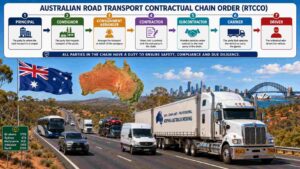
What’s a road transport contractual chain?
A road transport contractual chain is a chain or series of contracts or arrangements. Work is performed for a party to the 1st contract or arrangement in the chain or series, either by a regulated road transport contractor or a road transport employee-like worker under the services contract or by an employee. This chain or series needs that at least one party to the first contract or arrangement is a constitutional corporation. In simple terms, it’s a chain of contracts involving at least 1 enterprise. The first step is where the 1st customer contracts for road transport services, which are performed by an employee, a contractor or the transport provider.
Relevantly, a person is not in a road transport contractual chain if they have arranged for delivery or consignment solely for their private or domestic purposes. Alternatively, a person may not be part of a road transport contractual chain if they are a passenger being transported in a motor vehicle, limousine, hired car, bus, or coach. An employee performing work as a result of a road transport contractual chain (i.e., an employee of a transport enterprise) may also not be part of the chain.
Who’s a regulated road transport contractor or road transport employee-like worker?
An regulated road transport contractor meets all the criteria:
A regulated road transport contractor is a person (which can be an individual, corporate body, trust, or partnership) who may enter into a services contract and is responsible for performing all or a significant majority of the work outlined in that contract.
The person doesn’t perform any work under the services contract as an employee:
The work performed under the services contract is work in the road transport industry, and
The person is not an employee-like worker.
A services contract is a contract for services that relates to the performance of work under the contract by an individual, and
At least one party to the contract is
A constitutional corporation:
The Commonwealth or a Commonwealth authority, or
A body corporate incorporated in an Australian territory:
The work concerned is wholly or principally to be performed in an Australian territory:
The contract was entered into in an Australian territory:
At least 1 party to the contracts is a natural person who’s a resident in, or a corporate body that has its principal place of business in, an Australian territory:
The work concerned is performed in the course of constitutional trade of commerce, or
The contract was arranged or facilitated by a digital labour platform. The jurisdiction is where the operator of the digital labour platform is:
A constitutional corporation:
The Commonwealth or a Commonwealth authority:
A corporate body incorporated in an Australian territory, or
A natural person who’s resident in, or a corporate body that has its principal place of business in an Australian Territory.