
Warm welcome for PM Modi
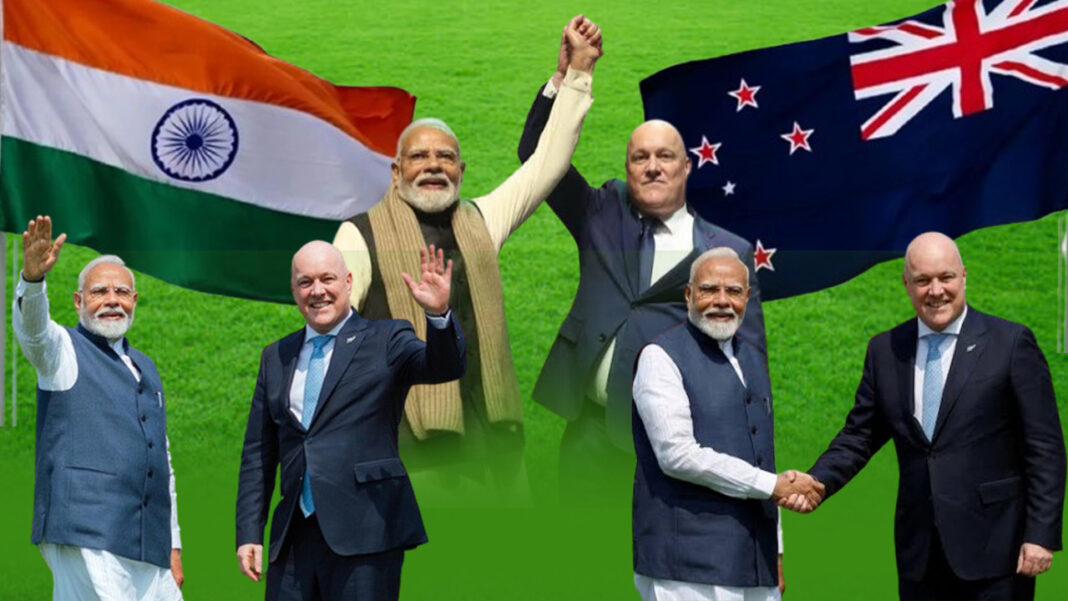
India (Commonwealth Union)_ Prime Minister Narendra Modi arrived in Auckland for the final leg of his three-nation tour, marking the first visit by an Indian prime minister to New Zealand in four decades. The significance of the visit was evident from the moment he landed, as New Zealand Prime Minister Christopher Luxon personally welcomed him at the airport, underscoring the importance both governments attached to enhancing bilateral relations. The official program commenced with a ceremonial reception at Government House in Auckland, where Modi was presented with a guard of honour and took part in a traditional Maori powhiri event, one of New Zealand’s most revered indigenous welcome ceremonies.
The event, rich with Maori customs, songs and cultural traditions, offered a window into the country’s heritage and set the stage for the high-level engagements that followed. The visit comes months after India and New Zealand signed their Free Trade Agreement, the negotiations for which started in March 2025 during Luxon’s visit to India and concluded in just over a year. In this context, the ceremonial welcome carried an added layer of diplomatic significance, signalling a new phase in the relationship between the two countries.
Meeting the Indian diaspora
One of Modi’s first public engagements was with the Indian community in Auckland, where thousands gathered to welcome him. The event at Spark Arena drew more than 10,000 members of the diaspora and turned into a colourful celebration of India’s cultural diversity. The program included performances from Punjab and Tamil Nadu, and a mix of Carnatic and Hindustani classical music. A rendition of Vande Mataram was met with loud applause, and the traditional dances and musical performances reflected the close cultural ties maintained by the Indian community, even living thousands of kilometres away from India.
Addressing the gathering, Modi described the relationship between India and New Zealand as one built on friendship, shared democratic values and people-to-people connections. He said the newly signed Free Trade Agreement would strengthen economic ties and support India’s journey towards becoming a developed nation. Recalling his first visit to New Zealand nearly three decades ago, long before entering public office, Modi shared a personal memory of receiving a muffler, a cap and a pair of gloves from a local resident. The anecdote drew warm applause from the audience and highlighted his long-standing connection with the country. He also spoke about similarities between the two nations, particularly their respect for indigenous traditions.
Referring to roads in New Zealand named after Indian cities, including Khandala and Amritsar, Modi said these reflected the lasting cultural links between the two societies. Prime Minister Luxon also addressed the gathering, praising the Indian community for its contribution to New Zealand’s economy, business and public life. He described India as a trusted partner and commended the pace of India’s economic transformation over the past decade. Luxon highlighted achievements ranging from infrastructure development and poverty reduction to advances in space technology, saying India’s growing global role would help shape the twenty-first century.
Also read: Modi’s Australia visit is a major boost for India-Australia relations: The strategic moves revealed!
Bilateral discussions
The central focus of the visit was the bilateral meeting between Modi and Luxon, during which both leaders reviewed the entire spectrum of India-New Zealand relations. Accordingly, trade, defence, investment, agriculture, education, tourism, sports, culture and technology featured prominently during the discussions. Both sides agreed that the recently concluded Free Trade Agreement should be implemented at the earliest to unlock new economic opportunities. The most important outcome of the talks was the elevation of bilateral ties to a strategic partnership supported by the “Roadmap to 2030.”
The framework outlines cooperation across defence, maritime security, scientific research, disaster management, tourism, sports and cultural exchanges over the coming years. The leaders announced a target of doubling bilateral trade by 2030. Trade between the two countries had already grown significantly in recent years, and Modi expressed confidence that the Free Trade Agreement would provide a strong basis for further growth. Modi also welcomed New Zealand’s planned long-term investment in India, calling it a partnership that would contribute to India’s economic growth.
Security cooperation emerged as another major area of discussion. Both countries agreed to establish a Joint Working Group on Counter-Terrorism and strengthen collaboration in combating emerging security challenges. The two leaders also endorsed a framework for maritime cooperation in the Indo-Pacific and announced an annual Maritime Security Dialogue involving their foreign ministries. Beyond bilateral issues, Modi and Luxon exchanged views on regional and global developments. They supported reforms of the United Nations, including expansion of the Security Council, and expressed concern over tensions in West Asia while emphasising the importance of dialogue and stability.
India-New Zealand Free Trade Pact
Economic cooperation remained one of the defining themes of the visit. During interactions with business leaders, Modi described the Free Trade Agreement as a landmark achievement that would open new opportunities for trade, investment and skilled talent mobility. He said the partnership between India and New Zealand rests on shared democratic values, diversity and a common commitment to sustainable development. These strengths, he noted, provide a solid foundation for expanding business cooperation across multiple sectors. Although the agreement has been signed, both countries are completing the remaining legal and parliamentary procedures before it comes into force. Even so, businesses on both sides are preparing for greater market access and stronger commercial partnerships once the agreement becomes operational.
Also read: The biggest takeaways from Modi’s Indonesia visit!
Agreements signed
The visit paved the way for a wide range of concrete outcomes designed to deepen cooperation across strategic and economic sectors. Among the agreements signed were arrangements covering defence cooperation, maritime collaboration, hydrography, logistics support between the Indian Navy and the New Zealand Defence Force, disaster management, tourism, sports, dairy development, animal husbandry and cultural exchanges. Both countries also launched the India-New Zealand Strategic Partnership and the Roadmap to 2030.
Other announcements included New Zealand joining the Global Biofuels Alliance, collaboration on Antarctic research, academic partnerships between leading institutions, the Kiwifruit Action Plan and cooperation on India’s National Maritime Heritage Complex at Lothal. Together, these initiatives reflected an effort to broaden the relationship well beyond trade by encouraging collaboration in science, education, agriculture, environmental research and cultural preservation.
The two leaders announced 18 outcomes during the visit, including 10 agreements and Memorandums of Understanding (MoUs), establishing an ambitious framework to strengthen bilateral cooperation in the years ahead. India and New Zealand signed 10 agreements during the visit:
- Maritime cooperation between the defence forces.
- Cooperation in hydrography and nautical cartography.
- Mutual logistics support between the Indian Navy and the New Zealand Defence Force.
- Establishment of a Joint Working Group on Counter-Terrorism.
- Cooperation in disaster management.
- Partnership in animal husbandry and dairy.
- Tourism cooperation.
- India-New Zealand Joint Action Plan on Sports.
- Collaboration on the National Maritime Heritage Complex at Lothal.
- Cultural cooperation.
The two leaders also made eight major announcements during the visit:
- Launch of the India-New Zealand Strategic Partnership and Roadmap to 2030.
- A target to double bilateral trade to NZ$7 billion (approximately ₹35,000 crore) by 2030.
- Establishment of a Maritime Security Dialogue.
- New Zealand’s participation in the maritime security pillar of the Indo-Pacific Oceans Initiative (IPOI).
- New Zealand joining the Global Biofuels Alliance.
- Launch of the Kiwifruit Action Plan and establishment of two Centres of Excellence in Nagaland and Uttarakhand.
- Antarctic research collaboration between NCPOR, Goa, and the University of Canterbury.
- Academic cooperation between NIFTEM-Kundli and Massey University.
India-New Zealand Business Event
Modi’s economic agenda continued at the India-New Zealand Business Event in Auckland, where he met leading business executives and investors from both countries. He invited New Zealand companies to participate in India’s Production Linked Incentive schemes, explaining that the programme offers opportunities across fourteen sectors ranging from food processing and textiles to advanced manufacturing. He encouraged investors to view India not only as a large consumer market but also as a reliable manufacturing and innovation partner. The Prime Minister also proposed greater engagement between young entrepreneurs from both countries. He suggested that business delegations made up of people below the age of 35 should regularly visit each other’s countries to build future commercial partnerships and strengthen long-term business links.
Also read: The horrific prison revolt: What triggered Sri Lanka’s deadliest prison riot?
Other engagements
Apart from official meetings, Modi participated in several engagements highlighting broader areas of cooperation. He also attended an exhibition of New Zealand’s sports technology and innovative sporting equipment with Prime Minister Luxon. Modern training tools and performance technologies were showcased by top athletes, hinting at possible collaboration in sports science and athlete development. Modi also discussed trade, technology, education and the strengthening of strategic partnerships between the two countries with New Zealand Opposition Leader Chris Hipkins, stressing bipartisan support in New Zealand for stronger ties with India. The two prime ministers later attended a gala lunch where discussions continued in a less formal environment, permitting interaction further between leaders and senior officials from both sides.
India-New Zealand relations
The visit reinforced the growing momentum in India-New Zealand relations at a time when both countries are seeking stronger economic and strategic partnerships in the Indo-Pacific. With bilateral trade already expanding and the Free Trade Agreement expected to boost commerce further, both governments expressed confidence that economic ties would grow substantially over the coming years. Alongside trade, cooperation is set to deepen in defence, maritime security, education, technology, agriculture and innovation. The Indian community in New Zealand is also significant and remains an important bridge between the two countries, helping to build stronger people-to-people links and supporting collaboration in business, politics and education.
Concluding the visit
Prime Minister Modi concluded his two-day visit in New Zealand after completing a packed schedule of diplomatic, economic and community engagements. Before departing Auckland, he thanked Prime Minister Luxon for the warm hospitality extended to him throughout the visit. Reflecting on the historic nature of the trip, Modi noted that it had ended a 40-year gap since the last visit by an Indian prime minister to New Zealand. He expressed hope that future exchanges at the highest level would become far more frequent, signalling a long-term commitment to stronger bilateral engagement.
Luxon personally saw Modi off at the airport as the Indian prime minister departed for home, bringing to a close a visit that combined ceremonial traditions, outreach to the Indian diaspora, business engagement and high-level diplomacy. The agreements finalized during the visit and the commencement of the strategic partnership provided a roadmap for augmenting cooperation in the fields of trade, security, education, science and cultural exchanges, signifying an important milestone in the growing relationship between India and New Zealand.