
India (Commonwealth Union)_ Prime Minister Narendra Modi’s visit to Bishkek was centred on the 26th Shanghai Cooperation Organisation (SCO) Summit, but its significance went beyond the two-day meeting. India used the visit to strengthen its engagement with Central Asia while also discussing developments in West Asia, the Russia-Ukraine conflict, terrorism, connectivity and regional security. Modi arrived in Kyrgyzstan at the invitation of President Sadyr Zhaparov. The visit brought together leaders from Central Asia, Russia, Iran and other countries, giving India an opportunity to pursue several diplomatic priorities from one platform.
For New Delhi, the SCO remains important because its members cover a large part of Eurasia. India has increasingly used the grouping to raise issues of terrorism, connectivity, trade and regional stability. This year, Modi placed particular emphasis on three themes: security, connectivity and opportunity. At the same time, his meetings with Iranian President Masoud Pezeshkian and Russian President Vladimir Putin showed how India’s Central Asian outreach is closely linked to developments in West Asia and the wider Eurasian region.
Also read: 18th BRICS Summit 2026: India hosts top global leaders in New Delhi as the world watches closely!
A warm welcome
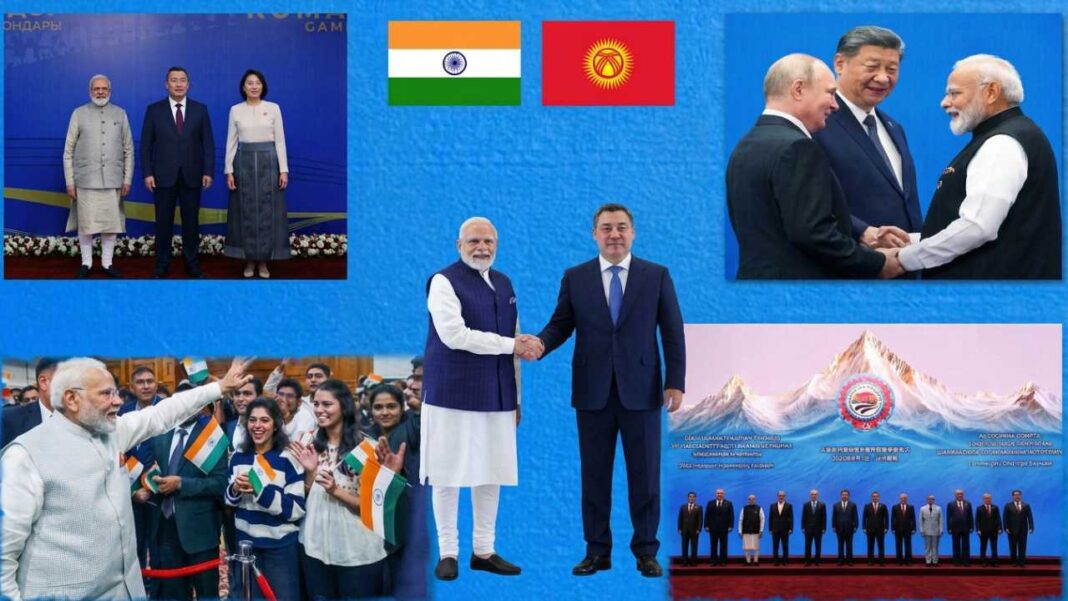
Modi received a traditional welcome when he arrived at Manas International Airport in Bishkek. Kyrgyz officials, cultural performers and yoga enthusiasts were among those who greeted him. The warm reception reflected the longstanding relationship between the two countries. India was among the early countries to establish diplomatic relations with independent Kyrgyzstan in 1992, and the two sides have maintained close political and cultural ties. The visit also came at a time when both countries are looking to expand economic cooperation. Areas such as infrastructure, renewable energy, tourism, technology, agriculture and pharmaceuticals offer room for greater Indian investment. For India, stronger ties with Kyrgyzstan are part of a larger effort to deepen its presence in Central Asia, a region that connects South Asia with Russia, China and the wider Eurasian space.
Meeting Indian diaspora
Modi also met members of the Indian community in Bishkek, including students, academics, researchers, ITEC alumni and yoga practitioners. The interaction highlighted the role of people-to-people connections in India’s foreign policy. Indian students, professionals and researchers living in Kyrgyzstan have become an important link between the two countries. Education, particularly medical education, remains one of the strongest areas of interaction. Thousands of Indian students have travelled to Kyrgyzstan for higher studies over the years. Modi’s engagement with the diaspora also underlined the importance India places on maintaining cultural and educational links alongside government-to-government relations.
Gifts exchanged
Cultural diplomacy was another feature of the visit. Modi presented Kyrgyz leaders with traditional Indian gifts that reflected the historical and cultural connections between the two countries. Kyrgyz President Sadyr Zhaparov received an English translation of the Mahabharata as well as a traditional Ladakhi Tsug-dul blanket. The Mahabharata’s themes of duty, justice and statecraft have a wider cultural resonance, while the Ladakhi textile reflects the shared mountain and pastoral traditions of India and Kyrgyzstan. Kyrgyz Prime Minister Adylbek Kasymaliev received a Dokra artwork showing traditional Indian musicians. The gift represented India’s traditional metal-casting heritage and its long association with music and storytelling. Such exchanges may appear symbolic, but they form part of India’s broader effort to build cultural familiarity across Central Asia.
Also read: How India steered BRICS towards consensus amid global divide!
Bilateral meeting
Modi held detailed talks with President Zhaparov on the sidelines of the SCO Summit. The two leaders reviewed the full range of India-Kyrgyzstan relations and discussed ways to expand economic and commercial cooperation. Trade, investment, healthcare, pharmaceuticals, information technology, agriculture, minerals, infrastructure and digital technology were among the areas discussed. The two sides also looked at education, tourism, sports and cultural exchanges. People-to-people ties were given particular importance, with student exchanges and greater cultural interaction seen as ways to deepen the relationship. Defence and security cooperation also featured in the discussions. Both countries expressed interest in expanding their existing links. For India, the bilateral relationship fits into its wider Central Asia strategy. Building stronger economic and security partnerships in the region can also support New Delhi’s broader connectivity and trade ambitions.
Mous signed
Several agreements and initiatives were discussed at the SCO level during the summit. They covered areas including climate change, nuclear safety, energy conservation and countering drug addiction. The summit also advanced cooperation on counter-terrorism and security challenges. Plans relating to international information security, biodiversity conservation and green technology were among the initiatives considered. These agreements reflected the changing role of the SCO. The organisation was initially built around security concerns, particularly terrorism, separatism and extremism. Its agenda has since expanded to include energy, technology, environment, trade and development. For India, this broader agenda creates space to pursue practical cooperation while continuing to raise security concerns.
The SCO Summit
The SCO Summit was the centrepiece of Modi’s Kyrgyzstan visit. Marking 25 years of the organisation, the meeting brought together leaders from across Eurasia at a time of major geopolitical tensions. Modi presented India’s vision for the SCO around three pillars: security, connectivity and opportunity. Security remained a major priority. Modi called for stronger international cooperation against terrorism and urged countries to dismantle the networks and financing systems that support terrorist activity. He also stressed that conflicts should be addressed through dialogue and diplomacy. This message was particularly relevant as wars and tensions continue to affect global trade, energy supplies and supply chains. His meeting with Putin reinforced this approach. Modi called for a peaceful resolution to the Russia-Ukraine conflict, while the two leaders also discussed their longstanding bilateral partnership.
The SCO summit also gave Modi an opportunity to engage directly with Iran. During his meeting with President Pezeshkian, the two leaders discussed bilateral ties as well as the situation in West Asia. India reiterated its preference for dialogue and diplomacy in addressing regional conflicts. This is significant for India because Central Asia and West Asia are not separate strategic theatres. Trade routes, energy supplies, maritime security and connectivity link the two regions. Iran, in particular, is important to India’s efforts to maintain access to Central Asia. The Bishkek summit therefore allowed India to connect its Central Asian diplomacy with its wider West Asian engagement. Modi also met Armenian Prime Minister Nikol Pashinyan and discussed cooperation in defence, pharmaceuticals, IT, space, education and technology. Meetings with leaders from Tajikistan, Mongolia, Laos and Togo further expanded his diplomatic engagements during the summit.
Announcement for Indian medical students
The visit also has relevance for Indian students studying in Kyrgyzstan, particularly those pursuing medicine. Kyrgyzstan has remained a popular destination for Indian medical students, making education an important part of the bilateral relationship. Modi’s discussions on healthcare and education highlighted the continuing importance of these sectors. However, the visit did not announce any special new rule or direct benefit for Indian MBBS students. Its significance lies mainly in the broader strengthening of India-Kyrgyzstan relations. The continued movement of students between the two countries is also part of the people-to-people partnership that India wants to expand.
Other engagements
Beyond the summit, Modi paid tribute at the Mahatma Gandhi Memorial in Bishkek and met members of the Indian diaspora. He also attended the opening ceremony of the sixth World Nomad Games. The event brought together leaders and visitors from different countries and celebrated the traditional culture of Central Asia. Modi’s participation added a cultural dimension to a visit otherwise dominated by diplomacy and security discussions. It also highlighted India’s interest in using tourism, culture and sports to strengthen its links with the region. His interaction with Putin before attending the event together also drew attention, reflecting the continuing importance of India-Russia ties.
India-Kyrgyzstan relations
India and Kyrgyzstan have built close ties over several decades, with education, healthcare, culture and people-to-people contacts forming the foundation of the relationship. Trade remains relatively modest, but both sides see potential for expansion. Kyrgyzstan exports products such as honey, dried fruits, beans and gold, while Indian products are also available in its markets. There is considerable scope for cooperation in tourism, medical tourism, pharmaceuticals, higher education, technology and industrial development. For India, Kyrgyzstan is also important because of its location in Central Asia. Deeper engagement with Bishkek can support New Delhi’s larger effort to build relationships across the region and strengthen its economic and strategic presence.
Concluding the visit
Modi’s Kyrgyzstan visit was driven by the SCO, but its agenda extended well beyond the summit hall. India used the visit to strengthen its relationship with Kyrgyzstan, engage Russia and Iran, discuss terrorism and regional security, and underline the importance of connectivity and economic cooperation. The focus on Iran and West Asian stability was particularly significant. India’s Central Asian strategy increasingly overlaps with its interests in West Asia, where energy, trade routes, maritime security and connectivity directly affect India. The SCO provided a useful platform for bringing these issues together.
Modi’s message of security, connectivity and opportunity reflected India’s attempt to build practical partnerships across a region facing major geopolitical changes. The visit, therefore, was not simply about strengthening ties with Kyrgyzstan. It was part of a broader diplomatic effort to connect India more closely with Central Asia while maintaining active engagement with key West Asian and Eurasian powers. For New Delhi, the next step will be to turn these diplomatic conversations into greater trade, investment, connectivity, educational exchanges and security cooperation. The Bishkek summit provided the platform; the challenge now is to translate the discussions into tangible outcomes.